The Pokemon Snap cards are Japanese prize cards from 1999, made from photographs that players took inside the Nintendo 64 game Pokemon Snap. Five contest winners each received 20 copies of their own card, so roughly 100 were printed in total. They are among the scarcest Pokemon cards that exist, and they almost never appear for sale.
What was the Pokemon Snap photo contest?
Pokemon Snap gave players a camera and a rail through a wildlife park, and the whole game was about photographing Pokemon well. Nintendo ran a contest in Japan around that idea.
The submission route is the part people forget. Players took their photographs in-game, then printed them at in-store machines that read the cartridge, and mailed the resulting prints in on postcards. There was no uploading anything. A physical print of a virtual photograph went through the post, and the best of them became cards.
How many Snap cards exist?
Five winners, 20 copies each, so about 100 cards in total. Each set of 20 came with a certificate.
That is a smaller print run than almost anything else collectors chase, and it is worth comparing to the numbers that usually get called rare. A trophy card with a few dozen copies is famous. A modern secret rare with a population in the hundreds is treated as scarce. The Snap cards sit below both, and unlike a trophy card there was never a competitive circuit of collectors around them.
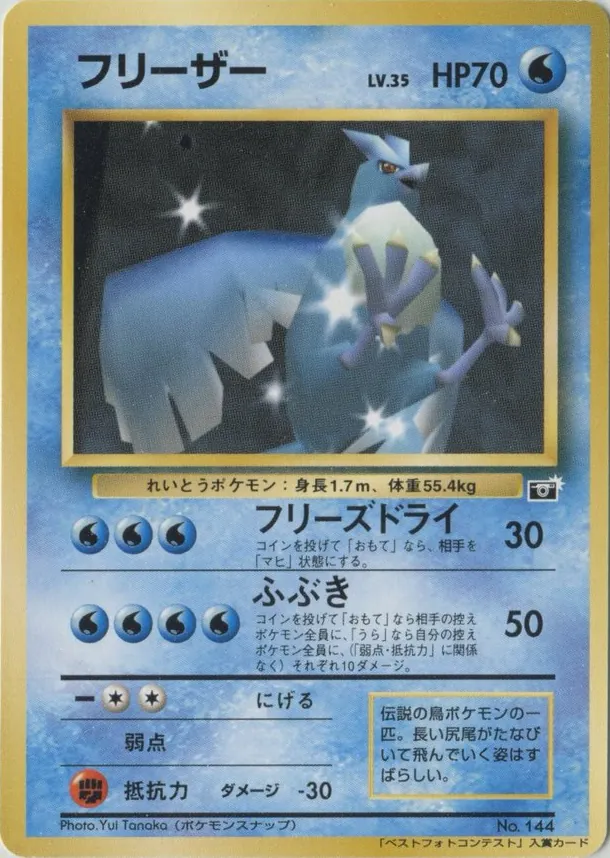
Which Pokemon are on them?
Here the record gets genuinely murky, and it is better to say so than to pick a number.
Poliwag, Pikachu, Bulbasaur, Magikarp, Articuno, Gyarados, Squirtle and Koffing all come up in collector discussion of the winning cards. That is more subjects than five winners with one card each would produce, so either the structure was more complicated than the simple account suggests, or some of those cards come from a different distribution. At least one account connects part of the count to a CoroCoro magazine release rather than the cartridge contest.
Gyarados is the one that surfaces most often. With a population this small that probably says more about who has sold than about what was printed.
Why do so few ever surface?
About a hundred cards were made and far fewer than a hundred have ever been seen, which is the question collectors keep returning to.
The likely answer is the same one that applies to most contest prizes. The winners were photographers and players, not collectors. Twenty copies given to someone in 1999 who thought of them as a memento are twenty copies that never entered the hobby's supply. Some will have been given away, some thrown out, and some are presumably still sitting with people who have no idea there is a market.
There is also an open question about whether the original postcards, carrying the submitted photographs, survive anywhere at all.
How do you tell a real one?
There is no published authentication method for these cards. The community record covers the contest, the winners and the distribution, but not the physical characteristics that would separate an original from a reproduction.
For a card this scarce and this valuable, that matters. The certificate that accompanied each set of 20 is the closest thing to documentation, and provenance traceable to a winner is worth considerably more than anything you can assess by looking at the card.
What are they worth?
Not a question anyone can answer cleanly, because there are barely any sales to reason from.
Individual copies have changed hands, and one seller is recorded as moving eight of the ten cards they held. Beyond that the market is thin enough that a single sale moves the perceived value of the whole category. If you want a card with a defensible price, this is not it. If you want one of the hardest Pokemon cards in the world to find, it is near the top of the list.