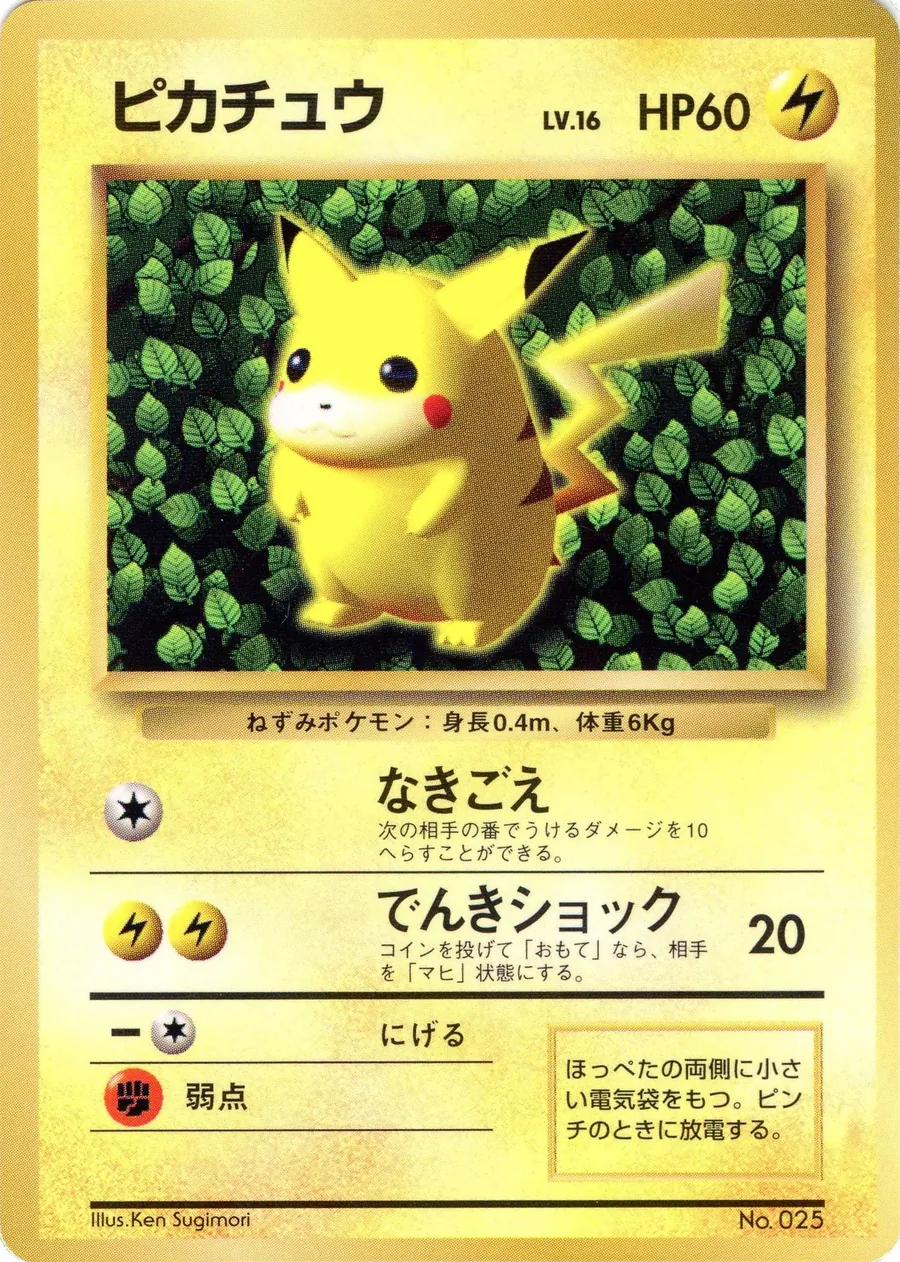
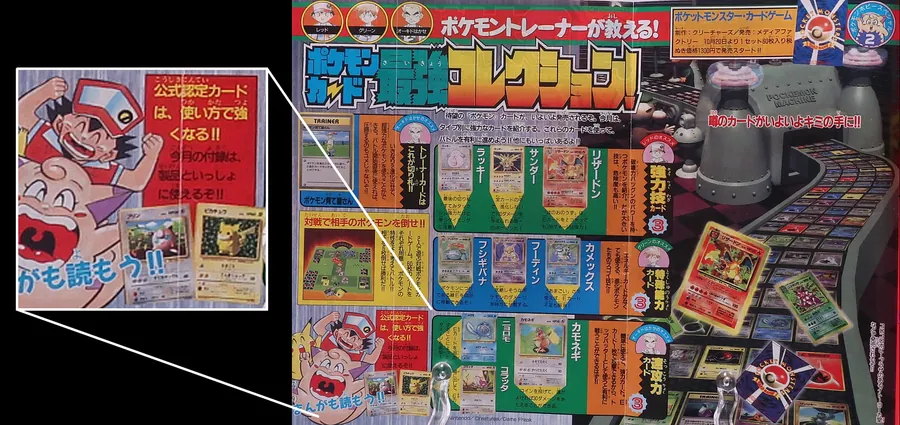
The Ivy Pikachu is the glossy Pikachu promo that Japanese readers peeled out of CoroCoro Comic issue 223 in October 1996, and it is generally accepted as the first Pokemon trading card game card ever released. There are three versions collectors actually chase, plus two edge cases that turn up in variant guides. The three are the 1996 glossy original, a non-glossy version from later the same year, and a glossy reprint from 1998.
Why is it called the Ivy Pikachu?
The nickname comes from the artwork. Pikachu is photographed as a small CG model against a dense wall of green leaves, and collectors started calling it the Ivy Pikachu to separate it from the many other Pikachu promos. Nothing official uses the name. The card itself is unnumbered, which is part of why the nicknames stuck.
Was the Ivy Pikachu really the first Pokemon card?
It was the first Pokemon TCG card, and that qualifier is doing real work. CoroCoro issue 223 went on sale on 15 October 1996, five days before the Japanese Base Set. Bandai's Carddass cards had already shipped earlier in 1996, but those were collectible cards with no game attached, so they sit outside the trading card game entirely.
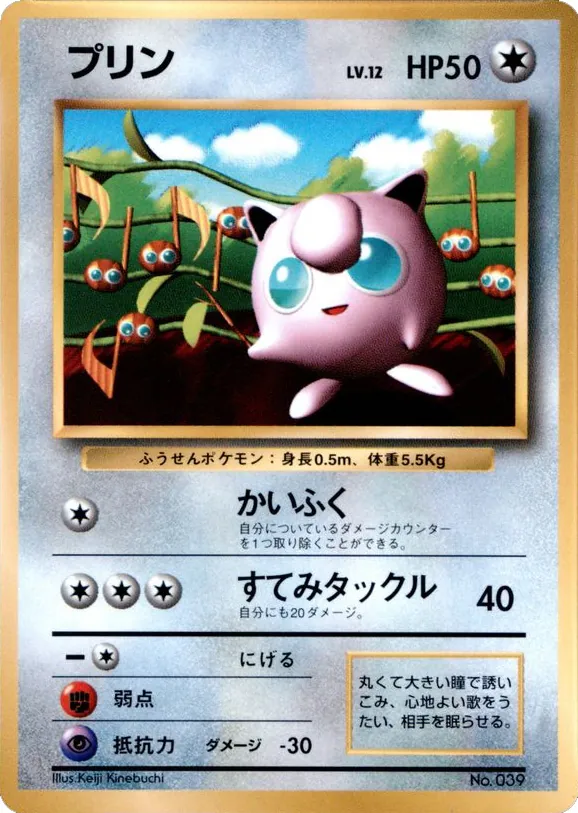
It is also not one card. The insert carried a Pikachu and a Jigglypuff side by side on the same sheet, so the honest phrasing is that the first Pokemon TCG cards were released together.
One more claim deserves a flag. For a while, inkjet-printed "playtest" and "prototype" cards circulated as predecessors to the TCG and sold for large sums. In January 2025 a collector known as PKMNFlyingMaster decoded the yellow tracking dots that colour printers embed in their output and found a print date of 2024. CGC had authenticated many of those cards and has since said it is investigating and looking at refunds. The playtest card scandal covers how that was worked out. If you see a card advertised as predating the CoroCoro promos, that history is the context you need.
What are the three main versions?
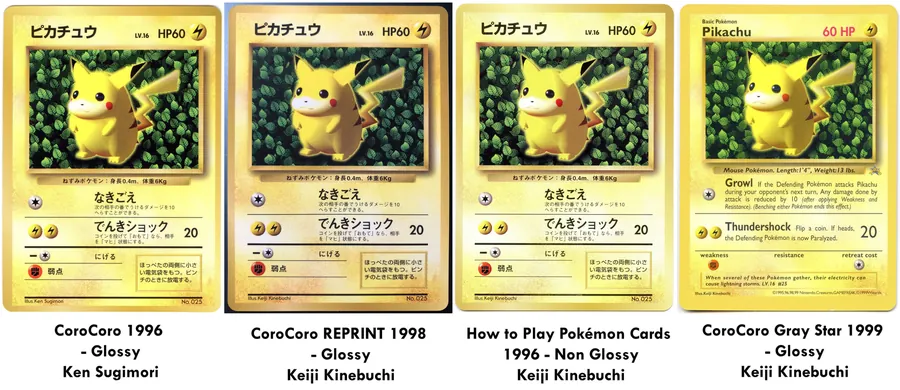
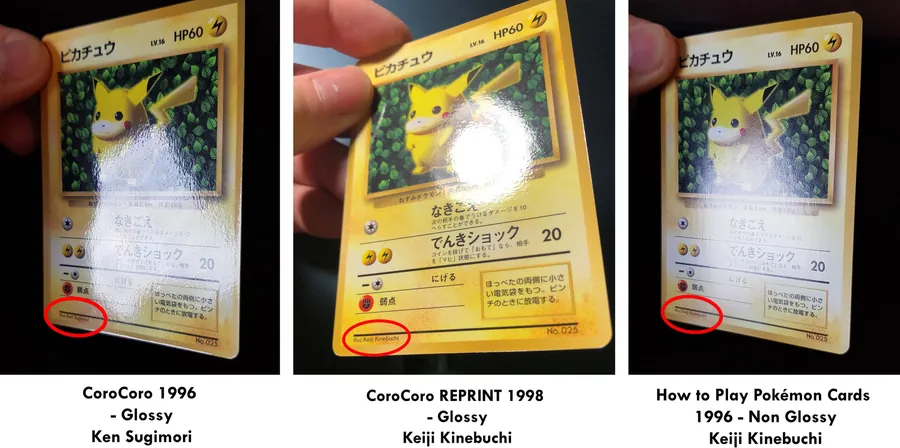
1996 glossy, incorrect illustrator. The original, distributed in CoroCoro issue 223. It has a glossy finish, deeper yellow colouring, and it credits Ken Sugimori at the bottom. That credit is wrong. The artist was Keiji Kinebuchi, and every copy from this printing carries the error.
1996 non-glossy, corrected illustrator. Distributed roughly six weeks later with the How to Play Pokemon guide from Media Factory. This is the only non-glossy printing. The finish is flat, the yellows are noticeably paler, and the credit reads Keiji Kinebuchi.
1998 glossy, corrected illustrator. A mail-in lottery reprint advertised in CoroCoro in October 1998. Glossy again, with the corrected credit. Roughly 2,000 people received a set of four cards, so about 2,000 of these exist. Collectors on Elite Fourum resolved a long-running argument about that number by checking the Japanese counter used in the original advert: it counts people, not cards.
The credit line is the fastest way to tell the 1996 original from either later printing.

What are the Gray Star and marketing variants?
Two more printings show up in variant guides, and both are genuinely obscure.
The Gray Star was distributed in March 1999 through Hyper CoroCoro. It was printed in English but only released in Japan, it uses the international card back rather than the Japanese one, and it carries a gray star with a PROMO stamp. It looks like a Western card that never went west.
The marketing variation is the odd one. Its artwork sits slightly differently: Pikachu is shifted right, the colouring is greener, and a pair of leaves sits under Pikachu's foot that is not on the released card. It credits Kinebuchi correctly. It appears in the magazine photography that advertised the promo, which suggests it was a proof used for print rather than a card meant for readers. Very few are known.
Why has nobody ever pulled a PSA 10?
No confirmed PSA 10 glossy Ivy Pikachu exists. PSA's population report has shown the occasional 10 over the years, but collectors who tracked those certificates down concluded they were non-glossy copies mislabelled as glossy. Somewhere between 1,000 and 1,500 copies have been graded without a clean result.
Three things stack against the card:
- Centering. Many copies came off the press off-centre. PSA's tolerance for a 10 is roughly 55/45 on the front and 75/25 on the back, and a large share of these fail on the front before anything else is assessed.
- The glue. The cards were stuck to a backing sheet. Peeling one can lift a layer of paper off the card back, and 30 years of adhesive does not get more cooperative.
- Compression. The sheet sat inside a thick magazine for decades, which produces faint bends that are close to invisible in a scan and obvious to a grader under raking light.
The non-glossy version has none of these problems, which is exactly why it grades well and sells for a fraction of the price.
What is a CoroCoro 223 worth, and why does peeling one destroy it?
An intact copy with both cards still attached is the scarcer object. In the CardBound documentary, collector John Nelson put roughly 19 intact copies in known hands against an estimate of about 80 surviving, and valued a copy without the cards at around $25,000–$30,000 and one with the cards attached at roughly $250,000–$500,000. Those are one collector's figures from a thin market, so treat them as a starting point rather than a price guide.
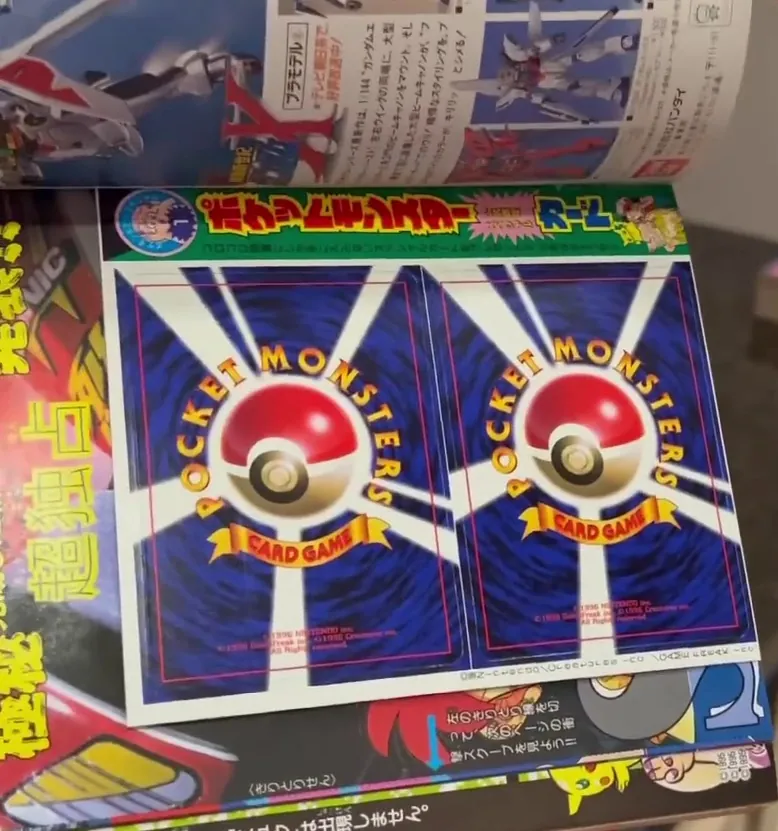
Peeling is irreversible in the way that matters commercially. Nelson's estimate is that removing the cards takes 80% to 95% off the book, because a graded book is then logged as incomplete. You are trading a scarce artefact for two cards that probably will not grade a 10.
Why did Logan Paul spend $2.7 million on this card?
In February 2026 Logan Paul sold his Pikachu Illustrator for $16.5 million. He then spent $2,713,096 assembling CoroCoro material with the aim of peeling the first PSA 10 glossy Pikachu himself, and released a video about it on 23 July 2026.
It did not work. An early peel from an intact book returned a PSA 5 for the Pikachu and a PSA 2 for the Jigglypuff, grades low enough that he had them re-examined at a second grading company, which pointed to bends he had not seen. He then bought pre-production sheets, which never sat inside a magazine and so avoid the compression problem, and peeled one live on 30 July 2026. Both cards came off intact and both were visibly off-centre. He called the Pikachu a nine himself.
The relevant part for anyone else is the reason it failed. He was not unlucky with a single copy. He bought the cleanest available material, learned the technique, and still could not get past a defect that was introduced when the cards were printed in 1996.
What should a collector take from this?
Population zero is usually a statement about manufacturing, not about how hard people have looked. When 1,000 graded copies produce no 10, the card is telling you the print run could not hold that standard. Cards like this can be worth owning, but the top grade is a lottery ticket rather than a plan.
The practical version: if you want the artwork, the non-glossy printing is cheap and grades well. If you want the history, the 1996 glossy is the one to buy, and buying it already graded saves you from the peel. Check the illustrator credit before you check anything else.